Showing posts with label Big Picture. Show all posts

Wednesday, January 8, 2020

Everything we need to know about teaching is in an 80s movie

On a Saturday way back in 2014 I was honored to present the keynote address at the Michigan Connected Educators Un/Conference. Here are my thoughts I shared with the group. The message is pretty timeless in the sense that six years later I believe this message even more. I have now updated my original post from what I shared with the conference back in '14. It's all still true today.

I started teaching in January of 1995. Who I thought I needed to be in the classroom was a combination of Michigan's legendary football coach Bo Schembechler and Sgt. Hulka from Stripes...and to some extent it was required. I took over a fourth grade classroom for a retiring teacher who had taken every Monday and Friday off the entire first semester. When I had been there eight days, it was the longest stretch of consistency these kids had had all year.

I had high expectations. I was loud with very low tolerance. I expected my students to be exactly like I had been as a student, compliant. Do what I ask when I ask it with few questions...It wasn’t very fun for any of us. I wondered how I would ever endure 30 more years of this.

In 1998 I faced what I figured would be a “make or break” task. I would be teaching a 5-6 split.  I would have six 6th graders who all were academically gifted in one way or another and seventeen fifth graders who hadn’t been selected for the previous year’s 4-5 split, primarily due to academics. How was I going to tackle this?

What got me through it was the power of using project based learning with the sixth graders....primarily to keep them occupied while I tried to get my 5th graders ready for the state assessment....MEAP test. That approach overtook my teaching that year and by June all kids were working on all kinds of projects and learning together in so many ways. It also became one of my favorite years of my career. You can smile and cheer instead of bark and gripe when your kids are constantly engaged.


That small group of sixth graders always reminded of the kids in My Science Project (watch the whole thing on YouTube) and from there I discovered that everything we need to know about engaging kids can be learned somewhere in an 80s movie.

Lesson 1: What makes tech useful in the classroom. I present to you the ultimate piece of educational technology. Just watch this trailer and think about how this phone booth  from Bill and Ted's Excellent Adventure does exactly what we want our technology to do.  These guys have incredible access to primary sources and get to witness history.  It is total immersion in content. 


If you remember how the film ends, these two put on an amazing rock concert-like oral report. They had the tools to gather information and then presented in a way that expressed the learning through their skills as rock and rollers.

The next lesson is to value the time together. We can not monopolize the time.  Jeff Spicoli actually makes a great point in the following clip from Fast Times at Ridgemont High.  Mr. Hand shouldn’t be the only one having all of the fun...if we can call it that.


There is probably a better way to set up a "feast on our time" though...but to Mr. Hand's credit, he cared enough about Jeff that he even went to Spicoli's house to make sure his surfing student completed enough work to graduate. Time called Mr. Hand the "original No Child Left Behind Teacher".

Image result for weird science

Lesson 3: Kids love to the make stuff but it’s our job though to channel that energy into the right opportunities. Gary and Wyatt learned the hard way about being  responsible with technology. Okay....this 3d printer might trump the phone booth for top tech honors but we are still talking about technology being used educationally!  Weird Science brings one more thought to mind. Did these "two guys" grow up to be Brian Briggs and Ryan O'Donnell, the Bedley Brothers, Brad Waid and Drew Minock, or Kyle Anderson and Joe Marquez?


Somewhat related to #3 is that kids just love to mess with stuff. Even back in 1983 before anyone knew what hacking was, War Games featured some random teens monkeying with North American Aerospace Command (NORAD) and its super sophisticated computer the WOPR. Then in 1986 a kid who looked a lot like the War Games kid was hacking his high school attendance computer so he could go to the museum and a Cubs game. Poor Ferris. He asked for a car and got a computer. Talk about being born under a bad sign. But....he had Internet in 1986. That's not all bad. I wonder if David Jakes ever bumped into Ferris' principal Ed Rooney in any Suburban Chicago educational circles. Rooney could have learned a lot from Jakes. 

#5 is a concept that took me a long time to get my head around. That inconvenient truth is that in the classroom you cannot use the same approach or lesson design for every kid. You have to diversify your instruction according to each kid's needs. No 80's film better exemplifies this than The Breakfast Club. The principal in the film, Mr. Vernon,  required them to each write a 1000 word essay about who they thought they were. Here is the essay Brian ended up writing for all of them.
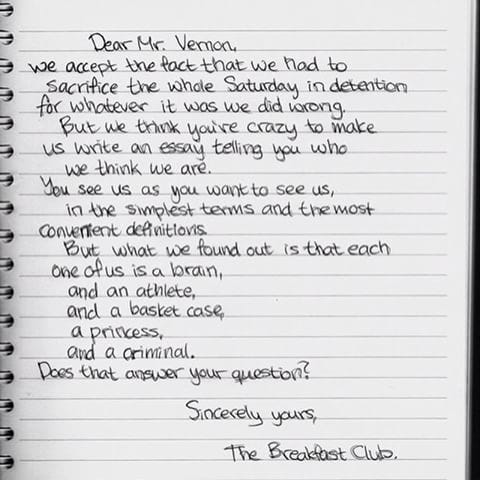
Image result for brian's essay from the breakfast club

He is exactly right. Let us never forget that every student is a complex human being and we need to foster development of their whole being.

Final lesson: It's not about you. It's about creating the right environment where kids can thrive. But, that doesn't mean you still can't be right in the middle of the learning fun. Robin Williams in Dead Poet's Society comes immediately to mind but I also give a big nod  to Bill and Ted's guide Rufus and quite possibly the coolest teacher ever captured n film, Mark Harmon's character Freddy Shoop from Summer School. 

Get in there and dig around with the kids just like Dean Shareski told us at MACUL back in 2014,

"It's not good enough to be the guide on the side anymore. Be the meddler in the middle."

It's been 25 years in the making for me but along the way teaching has become a lot more of an excellent adventure and a lot of a less bogus journey. All I needed to know about teaching is in the movies of the 80's. 

Tuesday, February 13, 2018

1:1 #SneakChat : Chromebooks, iPads, Running Shoes...It's all the same

Michigan district puts the skids on sneaker initiative.


The following is a fictitious "what if?" account of what usually happens when educators are blinded by the notion that 1:1 solves everything. It was originally posted in September of 2013...and still rings true.

What was initially hailed as a groundbreaking effort by the Rivermont Public School district (Mich.) to fight childhood obesity is now being re-examined and possibly moth-balled by school administrators over concerns of student mis-use. When students arrived at the district's three schools twenty-five minutes north of Grand Rapids this September, each was issued a new pair of Saucony running shoes in the nation's first ever 1:1 sneaker initiative. The district received a special mention on Good Morning America and a framed, hand-written letter of congratulations from First Lady Michelle Obama hangs in the foyer of each building.

Less than a month into the new school year, the district has slammed on the brakes and each teacher is being asked to collect the athletic shoes and store them in a closet until further notice. The holdup you ask?  Apparently the kids are having too much fun in them.

"Our grand vision was that students would use the sneakers for a school-wide fitness program that is guided by a rigorous curriculum of lap running and agility training throughout the day," stated superintendent Eli Tanis. "Our teachers are coming to us and telling us that the kids have no interest in these activities and instead are using the shoes for their own personal activities."

"Never before have we seen so much spontaneous running, noise, or such large groups of roaming mobs playing tag at recess. It can get terribly stressful," said first grade teacher Susan Vanderslice who has been at the same position for 31 years. "Before the shoes were just given to the children without any formal teacher training the playground was much calmer. Children simply milled around. It was very easy to maintain control."

After talking with a few students whose families asked that their identity be concealed to avoid any problems with staff at school, most kids don't see what they are doing wrong.

"They gave us these sweet shoes," says Fifth Grader (we'll call) Jake. "I couldn't wait to get on the court at recess and work on the cross-over dribble I have been perfecting this summer. Our teacher won't even let us wear the shoes outside though because he is afraid they will get dirty or something. He only lets us carry them to the track, put them on to run laps, take them off, and then carry them back inside. Running laps feels like doing penmanship."

Jake's parents echo their son's sentiments. "It seems like they are really missing the forest for the trees. They seem so focused on limiting what the kids do in the shoes. Shouldn't they just encourage any activity and movement at all? Take the time to teach the kids new games and give them time to just enjoy being active, whether that is outside when the weather is nice or inside once winter comes. We think that should be the ultimate goal, building healthy habits."

Rivermont curriculum director Shirley Wolverton defends the district's approach. "We have to insure growth. If we simply let the students play whatever they want in the shoes then there is no way to guarantee teachers will meet the benchmarks we have prescribed. If our lap numbers don't increase, our staff will have failed. The only way to increase a student's ability to run laps is to run more laps. "

A meeting is scheduled for Monday night at the school's board room where a sub-committee has been formed to investigate what modifications might be made to the program.

"We hope to have some answers quickly," Superintendent Tanis explains. "My biggest fear is that we will wait too long and the students will have all outgrown the shoes by the time we return them. We are also missing valuable lap-time on the track. Students need to know though that there is a difference between serious school work and the taxpayers of this community aren't financing just play."

Thankfully the above account is fictitious. There is no Rivermont, Michigan but unfortunately  this kind of thinking is far too prevalent in education. This silly post was the mental fruit cultivated by my hearing that Los Angeles Unified School District is temporarily moth-balling its one billion dollar 1:1 iPad efforts because students have easily hacked the devices' security controls.

Certain school districts seem so worried that students or in many cases staff will use a device for something other than "school work". We are not talking about accessing adult content here, but doing things like connecting with the rest of  the world through social media or making a multimedia project of vacation photos. To me, any time on the device that is not malicious or obviously inappropriate is learning. It is learning to use a tool to communicate and create. It is building comfort and efficiency within the operating system. The more you use it, the better you become.  (Author's Note: I am pumping the brakes on my own thinking here as it has evolved in the 5 years since I originally wrote this and especially in light of my recent post on Chromebook use. While still a believer that play equals better understanding of a device, we need to make sure we are smart about the activities and how we are using the time with the devices. We can design fun experiences that are learning-specific...but a moderate amount of free time is still okay now and then.)

Allowing kids to create content they are passionate about makes it all the more motivating for them to create a similar type of project on something being studied in the classroom. The same is true with giving every kid a pair of sneakers. Running laps isn't the only way to increase the ability to run laps.

Tuesday, February 21, 2017

"Wide-Open Spaces" Want creative thinkers? Help kids create, says Mitch Resnick – MIT Spectrum

THE LIFELONG KINDERGARTEN GROUP AT THE MIT MEDIA LAB, led by Mitchel Resnick SM ’88, PhD ’92, is known for its educational innovations: the Computer Clubhouse Network, an after-school environment where kids from underserved communities learn to express themselves creatively with new technologies; a 30-year collaboration with the LEGO company begun by Resnick’s mentor, the late MIT professor Seymour Papert, which yielded the robotics kits branded as LEGO Mindstorms; and Scratch, a visual programming language

Read an Interview with Mitchel Resnick on the idea of letting kids create: Wide-Open Spaces – MIT Spectrum

Wednesday, December 21, 2016

Embrace The Learning Curve This Christmas Morning


The more I talk to kids about what they are dreaming about showing up under the Christmas tree, the more I hear about really cool, high tech gadgets like virtual reality headsets, 3D printers, robots like Spheros or Ozobots, and drones.

Here is a newsflash. All of those items are amazing and all of those items can be really hard to use at the start. I am not trying to play The Grinch here; I am telling you now so you can be ready for the learning curve.

When kids dream of drones, they don't dream of a parent muttering words that could get them on the naughty list while trying to assemble it. They don't dream of an endless series of 3 second flights either. They dream of that thing lifting off in the living room and capturing with its camera the majesty of a Christmas morning. Reality is that these toys can make many dreams come true but it will take time. Here are some tips.

1. Prepare yourself. Whether you receive the gift or give the gift, understand that the cool stuff you saw happening in the YouTube promotional video probably was highly edited and performed by the inventors of the device. Make that kind of high level use your goal....someday, not right out of the box.

2. Seek out help. Speaking of YouTube, most companies now post many product support videos online. When I bought my XYZ Mini Maker 3D printer I found their online support videos to be far more detailed and helpful than the printed instructions. You can also often find videos created by other users of the product that share their own tweaks and helpful hints. Use all of the knowledge that exists and that people are willing to share. It can make a big difference.

3. Make it about the journey. Instead of pouting that your first 3D printed phone case turned out more like something stuck to the pan at the bottom of great grandma's egg casserole, have a laugh and know your skills will greatly improve. Try and figure out what went wrong so you can improve upon future designs. Keep that lumpy pile of goo so that when you are cranking out really cool stuff you can look back and see how far you have come. It has taken me months to produce anything really useful with my printer.

4. Remember 1 thing. Everything is awesome! We are so lucky to be living in the day and age we do....especially over the holidays. If you need a reminder, just listen to the old Christmas carol "Up on the Housetop." Here is what those kids got from Dear Old Saint Nick:

"Next comes the stocking of little Will
Oh, just see what a glorious fill
Here is a hammer and lots of tacks
Also a ball and a whip that cracks"

No VR headset for little Will? Bummer. Poor Will probably had to go fix the roof and then drive the oxen to town that day once all of the wrapping paper was cleaned up. The point is.....if you get something amazing, be grateful, and when (not if) it doesn't work perfectly right at the start, be happy about that. Don't get mad. Getter better at it.

Tuesday, May 31, 2016

10 Ways To Stop the Summer Slide

The following was posted for my elementary kids on my classroom blog mrlosik.blogspot.com.  I am sharing it here to offer up some ideas teachers can use to help their own students avoid the "summer slide".


Don't let the last nine months of hard work simply slip away. Here are tens ways to keep the knowledge, creativity, and problem solving growing.

1. Read. Our local libraries are amazing places and wonderfully cool on hot days. Holland's Herrick District Library has lot of summer activities planned and so does the Saugatuck Douglas Library. The Kent District Library in Grand Rapids does too if your family is up for a little reading road trip. Best of all, they are all free. Another free online resource is the Michigan Electronic Library's kids section.

Your family can also sign up for Epic Books and have unlimited access to all kinds of digital books for your iPad or tablet. Think of it like Netflix for books with tons of the best titles like Big Nate and Bad Kitty. Epic is $4.99 per month and the first month is free. That's less than a pizza and whether you like fiction or non-fiction, there is something for everybody.

2. Practice Math Facts. Teaching and learning are a lot like playing sports. Professional football players don't just sit around all summer waiting for training camp. They are doing something everyday to become faster, stronger, and smarter. Whether it's running, lifting weights, or perfecting how to better cover a pass, they know without it, they won't be successful. The same is true with math facts. The more they become automatic, the more you can move on to more exciting stuff. Spend time on IXL and XtraMath this summer building your speed, strength, and brain. Here is the Blue Star IXL login.

3. Build Something. One of the main reasons we do math is so we can make cool stuff. Anybody can be a worksheet monkey but is really special to do something with your math skills. Whether you are just nailing wood together on a workbench or creating your own iPad speakers you have to be able to measure your pieces and solve equations. Check out Instructables.com and you will be amazed at all of the projects from simple to mind-blowing. Most even use things you just have lying around the house.

4. Get Outside and Explore. Did you know that in Michigan you are never more than six miles from water? West Michigan is literally one of the best places on earth to spend the summer. Whether it is a visit to a park, the woods, or the beach there are great places to explore just minutes from your house.  The Shore Acres Park near the Felt Mansion has all of that and more. Walk the trails and check out the different trees and then look for fossils, sea glass, and special rocks on beach. The Lake Michigan Rock Picker's Guide is a great book for identifying what you find. Here is a cool blog with some other information. Pier Cove, Westside County Park, Douglas Beach, and Laketown Beach are all free and close by.

5. Grow Something and Eat It. You might live on a big farm or you might live in a tiny apartment, but everyone has enough room for a flower pot or planter. Go big on a whole garden or just spend a buck or two on some green bean seeds and plant them in sturdy pot. Give them water and sun and soon you will have a beanstalk offering up a crisp healthy snack. Gardening Fundamentals  is a great place to start. Print out the journal to track your gardening.

6. Learn to Code. Why just play video games when you can learn an entire new language and build your own? Visit CODE.org and work on a couple of challenges like the Mindcraft, Star Wars or Frozen ones. If you get caught by the coding bug, keep going and try one of their 20 Hour Courses. There is something for every grade level from pre-school on up. Completing these courses will actually give you a nice boost on a career in computer science or set you up to build your own game.


7. Catch the Olympic Spirit. The world's best athletes are headed to Rio de Janeiro in August for the 2016 summer Olympics. Sharpen your geography and boost your knowledge by digging into the history of the games, researching your favorite athletes, and making the flags you find most interesting. Teachervision.com has a great site for getting started. NBC will provide hundreds of hours of coverage but you don't have to wait until August. Check out NBCOlympics.com now to learn all about what is coming up from Rio.


8. Play60. Just go outside and play. You don't have to spend money going to a sports or summer camp. It doesn't even matter if there are any other kids around either. Speaking of Olympics, set up your own events even if you just draw a line, pick up a rock, and jump as far as you can. Set the rock down next to where your back heel landed. Try to beat it. If you want to do some moving with a pro athlete, check out Washington Redskins' Ryan Kerrigan leading some agility activities from Discovery Education and the NFL. Getting creative outside is great for mind and body.


9. Go new places. If you have opportunity to take a trip, understand how lucky you are to be getting out and experiencing new places. Just paying attention to how the scenery changes or the importance of physical and human-created landmarks is the best social studies lesson anybody can have. Even if it doesn't work out for your family to embark on an epic journey just go somewhere different like a park you've never explored. Try to unplug as much as possible but if you are going to bring along a device use it to capture and then share the adventure. Here are some great apps for that.


10. Do Something For Someone Else. No matter what you do this summer, do something for someone else. The real reward is the feeling you get inside. I've always believed true friendship is true service so just randomly decide to help someone do something like empty the dishwasher or even clean your room without being told. The more you volunteer your time and talents, the more likely you will return to school in the fall ready to be the kind of kid that makes any school a better place to be.

Our summer vacation is something we can't take for granted. Find a nice balance of recovering from this school year, resting up for the next one, and finding ways to keep your brain firing while you make it the best one ever!


Thursday, May 19, 2016

10 Ways Glowforge Can Disrupt Education

It's been a long time since I have been more excited about the introduction of a piece of technology than I am for the Glowforge.


Aside from all of the personal ways I can see Glowforge help bring my creativity to life, this single device has the potential to revolutionize so many of the ways we do things in the typical school. I have often said, "There is a lot of money to be made in education...just not in teaching." Schools spend a ton of money that goes to vendors, but here are 10 ways a single Glowforge can change that.

1. Die Cut Letters - The Ellison die cut machines have dominated the bulletin board making market my entire career and their stuff is expensive. A single set of alphabet tiles runs $500 and it takes a ton of time to plan and cut that "Hurry Spring" signage. With a Glowforge you can throw a stack of construction paper into the machine and have your whole set of cut-outs zipped out in a couple of minutes...and you're not stuck with one font either. If you can type it on an device, you can cut it out of construction paper.

2. Mothers Day Gifts - Think about the huge ramp-up in production value that the average elementary school class could do when it comes to personalized gift crafting. Goodbye paper plate bouquets and hello personalized wooden votive candle holders.

3. Awards and Trophies - Athletic departments and honor societies spend huge amounts of their budgets on trophies, plaques, and awards. Think about the amount of money that could be saved if schools just bought the raw materials and engraved all of their own awards. What if a school created a class where kids designed and created all of the awards? A teacher may have to do final names but 90% of the work could be student driven and done at a fraction of the dough Ned at the trophy shop is charging.

4. Inventory Engraving - Speaking of engraving...instead of a jittery hand with an engraving pen or a sticker that is easily removed, schools could engrave items like laptops and iPads with attractive, permanent identifiers. Check out what Glowforge designers have done with a Macbook.


5. Staff ID Badges - Get creative and save money by creating personalized staff or visitor badges by cutting and engraving them from your choice of materials.

6. Pro-Style Locker Labels - If you have ever seen an interview from a professional or big-time college sports locker room then you've seen the fancy headers above each locker sporting the athlete's name, number, and team logo. With some creativity and cheap 1"x2" lumber, a school could give its athletes the pro treatment.

7. School Spirit Items - Lots of schools sell items as fundraisers and to boost school spirit. Instead of eating up profits by going to one of the national suppliers, schools could begin buying blank stock items and doing the engraving and laser cutting themselves with a Glowforge. You can't screen print with it but you can create some amazing luggage tags, pendants, and other personalized signage that can generate spirit, pride, and revenue.

8. Etsy Class - Think of all of the economics and entrepreneurship that can be experienced when students begin to design, create, and market products with a Glowforge. With sites like Etsy and Mercari as global marketplaces, individual students may begin to peddle their wares  to the far reaches of the Internet. It sure beats 180 days of PowerPoint lectures and worksheets.

9. Trick Out Your Office Space - With every Glowforge purchase comes access to the members' catalog that features projects ready to print and assembly. This iPhone stand is one example of the cool stuff that staff can create for themselves and add a high end, start-up, feel to the workplace. There are a ton of neat items like this available. Glowforge features a similar computer stand in many of its promotional materials that was cut as flat pieces and then glued together.

10. Hands-on Classroom Products - Instead of buying any of these items, just create your own.

•Wooden or Acrylic Cut-out Letters and Numbers for the early elementary classroom


•Wooden or Acrylic Cut-out Shapes or other math manipulates that can be used K-12


•3D Geometrical Shapes that can be cut from all kinds of materials from cardboard to plastics


•United States or World Puzzles cut from plywood or plastic. Team with the art teacher and have kids paint and label each state or country.


•3D Models of Landmarks can be elaborately created by cutting flat slices and assembling a bunch of pieces like this Space Needle or just cut and engrave a 2D image on piece of wood thick enough to stand up on its own or with a small additional brace.


Like I said, I haven't been more excited about a piece of technology in a long time. It can turn all kinds of creative dreams into reality but it has nearly infinite potential to impact how we do things and what we can create in our schools.

Monday, March 7, 2016

"Participation Medals Are Not the Real World": the Wit and Wisdom of Curt Schilling

Last night I had the opportunity to visit my alma mater Hillsdale College and the kickoff to its "Sports and Character" symposium.

World Series MVP Curt Schilling was the speaker and leadership was his primary theme. Schilling is best remembered for his bloody sock in Game Six of the ALCS in 2004. A lot was made of the courage it took for Schilling to pitch with an ankle tendon sutured in place and that he was a hero to the long suffering Red Sox nation.


"I only did what I thought every one of my teammates would have done," Schilling stated. "In our world the words 'hero', 'great', and 'courage' have really been diminished." He also mentioned that he had never been more at ease on the mound and credited a casual conversation with God that eased the nerves and any doubts about the ankle holding up. "That night I had a moment of true faith. Never in my life was I more relaxed and enjoyed playing the game more."

Most of the night's talk was a set of stories of both sporting and personal highs and lows. It's quite evident that Schilling has taken every experience and learned something that has either helped him grow or is something he can share to help others grow as well.

[caption id="attachment_1345" align="alignleft" width="225"]12799020_10153440282689013_5598975390458915915_n Curt Schilling sharing his life experiences on Sunday night.[/caption]

Here are some quotes on a number of topics that give insight into the wit and wisdom of Curt Schilling.

On parents who push their kids too much in sports: "If you make your kid love a sport they will quit the minute you can't make them love it anymore."

On the "real world" that the college students will soon face: "Participation medals aren't the real world." and "If you leave your house every morning waiting to be patted on the ass for a job well done, it's not going to happen. That's because the rest of the world now is too busy waiting to be patted on the ass for a job well done."

On becoming the first team in Major League history to come back from a three games to none deficit in the 2004 American League Championship Series: "I told my teammates down 0-3 that we don't have to win the next four games. We don't have to even win the next game. All we have to do is win the next at-bat and the at-bat after that and we'll be fine. Just focus at the task at hand."

What I found most applicable to my career as an educator was the time he spent talking about leadership and accountability.

"Anyone can be a leader but there are so few true leaders."

"Leaders get paid to produce. Everyone else gets paid to work."

"You can get a job anywhere but it is really hard to find a place where you are inspired everyday. That's what real leaders do. They inspire people who are excited to come do what it is they do everyday."

On lessons in accountability he learned from the failure of his 38 Studios video game company and the $50,000,000 he lost of his own money in the venture.

"When you put your head on your pillow there's no escaping by making excuses that losing the 50 million was somebody else's fault...If you want to know what accountability is try having to tell someone their job no longer exists because of your mistakes."

Another part of the talk that really resonated with my life as a technology teacher and a dad of a daughter. A year ago Schilling began receiving an onslaught vulgar tweets directed at his daughter Gabby. Using his tech skills, Schilling tracked down the trolls and contacted their parents, bosses, and colleges. Several of the trolls were college athletes and immediately were cut from their respective teams.

"4 kids lost $140,000 of scholarships for 140 characters."

"It's hard to explain to kids 'forever' because the Internet is forever."

All insightful thoughts. Probably the best thing that Curt Schilling modeled on Sunday night in Hillsdale is that you can be a world famous professional athlete but you still face the same ups and downs and trials that everyone else faces. The key is to learn from each of those trials and grow.

An hour well spent.


Thursday, February 25, 2016

It's Time for an Educational Jailbreak

Coding, Maker Space, Video, Photography, Graphic Design, Sound Engineering, and countless other great educational innovations have suffered far too long in the educational prisons of the world. It is time we break them out and truly integrate them into the core curriculum.

Coding is math. Video editing is story telling. Making is practical application of all kinds of "core" skills. They have to move though beyond being viewed as clubs, fun Friday activities, or just stuff hippies do to avoid integrating fully into society.

The education establishment has this terrible tendency to bottle up and lock away approaches to teaching and learning that don't look like something it experienced in the classroom twenty years ago or worse isn't obviously a part of subject areas measured by state assessments.

My former district took away specials like gym and art and made them test prep time. Recess was all but eliminated for more reading instruction. So much for educating the whole child.

This has to stop.

We can lament this all we want and nothing will change or we can begin to focus on the pedagogy and develop sound ways that coding builds success in the algebra classroom and that iMovie Book Trailers build excitement for reading and a demonstration of literacy. That is how we break down the prison walls that are keeping great innovation on the fringes of education and not at its core.

Monday, January 18, 2016

A Simple Approach To Dealing With Personal Devices In The Classroom

I have long been an advocate for bring your own device (BYOD) in the classroom. I figure that if kids have tools that know well and use well, then there is no reason to restrict them from using them in the classroom.

Key word there: tools, as in apps for learning.

Too many of the teachers who are frustrated with dealing with personal devices often don't take the learning tools approach. Instead of allowing for specific purposes they end up policing. They collect phones ahead of class or insist on no devices being out at any time. Kids at our high school have even started bringing old phones to turn in at the beginning of class so they can still access their working devices.

I'm not naive enough to think that every time a kid has a device out in the library, they are using it solely for a learning activity. What I do know from 20+ years in the classroom that kids for the most part respond well when you give them some clear expectations and put the responsibility on them to do the right thing.

Despite spending a lot of time on this early in the year I too have had some frustration with our students in the library who are taking online classes. Too many are "forgetting" or just seeing how much they can push our guidelines with personal devices. Usually a friendly reminder gets everybody back on track. Sometimes it takes a few reminders.

Here is a new poster adorning our work stations. The kids got a laugh out of the devices I chose but more importantly the "got" the message.

Screen Shot 2016-01-18 at 9.22.52 AM

Friday, December 11, 2015

Think Different Tim Cook: 10 Reasons Chromebooks Are Winning...And It Has Nothing To Do With Testing

[caption id="" align="alignnone" width="990"] Apple CEO Tim Cook calls Chrome devices "test machines" - Buzzfeed Photo[/caption]

On Wednesday in a Buzzfeed interview, Apple CEO Tim Cook called Chromebooks "test machines" and cited Google's take over of the education market as primarily a result of schools just buying hardware for standardized assessments.

There is no denying that recent mass purchases from school districts have been in response to needing more equipment for tests that have moved from paper to web browser. What is in question is why schools are choosing Chromebooks over Macs and iPads. Cook sells educational leaders and teachers short when he implies that testing is all that went into the decision making and all that is being done with the products once they reach schools.

Now, don't write me off as a hater. Heck, one of the proudest recognitions I have received is that of being named an Apple Distinguished Educator. I am a huge Apple advocate and I truly believe that Cupertino builds the most durable and best designed products in the tech world. For a long long time Apple won the classroom because its stuff "just worked" and it still does. The six-year-old  Macbooks I teach with just hum along. The three-year-old cart of HPs...don't.  The iPad has opened worlds previously un-explorable to people with disabilities. Apple has done great things in the classroom and I still believe schools need a number of Macs or iPads around for tasks Chrome devices can't. I am just not convinced anymore that Apple products are the only solution.

Here Mr. Cook are 10 reasons why educators are choosing Chrome devices over Apple products...and they don't have anything to do with testing.

  1. The Reality of Classroom Technology Integration - “We create products that are whole solutions for people — that allow kids to learn how to create and engage on a different level,” Cook stated in the and he's correct. iMovie, Keynote, Pages, Final Cut Pro, Motion, and other high level apps are the staples when it comes to kids creating high level content. The only problem for Apple is that the vast majority of students and teachers don't learn and teach constantly at this level. As great as all of these Apple tools are, right or wrong, they have taken a support role to the tools students and teachers use most.The SAMR framework discusses how teachers use tech at varied levels between basic "substitution" and creating previously inconceivable activities in a level defined as "redefinition". The Apple stuff excels in the hands of teachers who have mastered ways of getting to redefinition but the vast majority of educators are somewhere in the middle and most of the learning tasks they ask students to do with technology doesn't require the high end apps.

  2. Price - Chrome devices continue to drop in price to the point where schools can buy five Chromebooks with touchscreens for the price of one Macbook. It's hard to justify the extra cost if the job can be done with a solid device at a fraction of the money. I just bought a fully functioning Chrome computer in the $85 Chromebit. $85! Yes it requires me to connect it to an HDMI display and I have to supply the keyboard and mouse but that price point alone makes it wildly affordable for a number of functions around a school.

  3. They Just Work - It is still the number one reason I always choose Apple stuff over Windows stuff and I was very suspect of the Chrome products when they first hit the market. Aside from getting used to the layout of where everything is on these devices my experience has been that the simplicity of the Chrome "just works" as well. With less operating system there are less hassles.

  4. Ease of Management - Managing a cart of iPads is incredibly time consuming and not something most classroom teachers are entrusted to do. Apple has put out a series of management solutions but none have been the silver bullet that actually make life easier for teachers. With Chrome there is virtually no management because when a kid logs in with their Google Apps for Education account, all of their stuff is available.

  5. Google Apps - No, the free suite won't let you make your documents as cute as Word or Pages will, but with a little skill you and your kids can get darn close. Cute isn't deal closer on GAFE though. Storage is unlimited for schools and with a little foresight educators can help kids set up portfolios that will follow them all of the way through high school. No one will ever lose their work due to a dead laptop battery because Google saves every few seconds. Plus, it's just automatically already set up with every Google account. Yes, Apple offers a version of its iWork suite online for free and it can do a lot but space is limited and the sharing options aren't close to what GAFE does. What is really cool though is that if you want to use the online versions of iLife you can do it on a Chromebook.

  6. Collaboration - The whole game changed way back in the day when Google bought Writely from an upstart called Upstartle. Simply being able to edit something simultaneously ten years ago was groundbreaking. Google has used the last decade to further enhance the collaborative capabilities. Apple is bringing that to iLife but are essentially playing catch up. The collaboration built into a Google Apps/Chrome environment helps teachers better communicate with students and provide useful feedback. The same is true with students communicating and collaborating better with each other.

  7. Google Classroom - From its introduction teachers have been flocking to the free learning management system. As it evolves and becomes more stable it is becoming the go-to, even by die hard Edmodo and Schoology users. What is the big deal? See all six of the previous reasons. Seriously, you can apply all of them. As a classroom teacher, paper was my Achilles heel. In Classroom it's all digital and the interface shows who has completed work and who hasn't. Once it's turned in, it's locked until the teacher grades and returns it. Apple offers iTunes U which is a beautiful way to present content and develop courses that don't rely on Internet connectivity but they only run on an Apple device. Classroom works everywhere.

  8. Access Everywhere - Speaking working everywhere, students and teachers can access the work they started on the Chrome device at school anywhere they can find a web browser with an Internet connection. It is something kids have come to take completely for granted. Ubiquitous access is their normal. A perfect example was when we were making book report trailers on iMovie and my students all wanted to know how they could find their work when they got home so they could continue working. They were put off when I told them it was only available on the one device they'd been using.

  9. Open To Innovation - Google Apps has evolved at light speed because of the way individuals can create add-ons. Doctopus and Goobric are examples of innovation created by a user that have made the product better fit teacher needs. This isn't just in Docs either. There are a ton of new Chrome apps being developed that bring a lot of the creativity and depth of exploration to the Chrome browser.  Apple obviously innovates all of the time too but doesn't adapt as fast as Google because the innovation all takes place within Apple.

  10. Big Yet Nimble - Lebron James and Cam Newton are special athletes because they are big yet have uncharacteristic speed. Google Chrome and the devices that run it are a lot like that. Google is massive with unlimited resources to support its products yet has retained a simplicity that makes stuff work at the highest level of efficiency. There is no reason to expect that won't continue to be the case.


Ultimately schools have to find the platforms and devices that work best for their needs. I always have a Mac nearby because I use so many levels of its functionality. My students don't always need the firepower and Google is picking up a lot of believers in educators who see all of the benefits Chrome devices can deliver at a fraction of the cost.

I understand and appreciate Tim Cook's passion for giving educators and learners amazing stuff but if Chrome devices are just "test machines", he needs to Think Different. 

Sunday, November 8, 2015

How Colorado teenagers hid a massive nude sexting ring from parents and teachers - The Washington Post

Here is a must-read wakeup call for educators and families. Kids will probably always out-pace us in the deception race but we owe it to them and ourselves to at least stay in the race.
Disguised to look and function like an innocent smartphone app, photo vaults — also known as “ghost apps” — allow people to conceal photos, video and information in plain view on their phone. They’ve been around since at least 2011, but have grown increasingly common as smartphones have gained popularity. The App Store and Google Play are littered with apps designed to help users hide their activity and camouflage sensitive information. “If you look at your kid’s phone, everything looks normal, but one of

Source: How Colorado teenagers hid a massive nude sexting ring from parents and teachers - The Washington Post

Tuesday, October 27, 2015

Rubik's Cube: A question, waiting to be answered - Google

[embed]https://www.youtube.com/watch?v=W1K2jdjLhbo&feature=youtu.be[/embed]
Rubik's cube is more than a puzzle- it's a question waiting to be answered. And when the right person finds the right question, it can set them on a journey to change the world. We salute ErnÅ‘ Rubik and everyone helping young minds find the questions that challenge, excite, and let them see the world in a new way. See artists and designers remixing the Rubik's Cube at http://chrome.com/cubelab ~Google

Friday, October 2, 2015

Don't Judge these Sorority Girls for Taking Selfies


[embed]https://www.youtube.com/watch?v=ecjyR59qw1M&feature=youtu.be&list=PL3ZQ5CpNulQmg11sF8YZgXqBoNQTWpo42[/embed]

It was a night out at Chase Field for some sisters from Alpha Chi Omega and the Fox Sports Arizona announcers had lots of fun commenting on the barrage of selfies the girls were taking.

The video quickly went viral with no doubt  the stereo-types of self-absorbed girls completely engrossed in a self-absorbed session of selfies fueling the fire.

When the Diamondbacks tracked down the girls to offer them tickets to a future game, the ladies of A Chi O revealed a completely different side of themselves and their organization. Instead of accepting the tickets the sorority asked that they be given to their national philanthropy A New Leaf,  an organization that supports victims of domestic violence. The sorority is now using the ensuing publicity to generate even more support for the cause.

This is a great example of how quickly society jumps to conclusions about people and how inaccurate they can be. As educators we have to be really careful not to do the same thing in our classrooms by pegging kids with our own assumptions.

Great job Alpha Chi Omega!

Thursday, September 17, 2015

@EdtechHulk Say It All 'Bout Bad PowerPoint

Sometimes the silliest things make the most sense. A tweet this afternoon from the always entertaining @edtechhulk sums up my thoughts on bad PowerPoints to a tee.

HULK MANIFESTO

Wednesday, May 27, 2015

Education on Air- Keynote from Jennie Magiera: "Power to the pupil" - YouTube

The definite high point for me of the recent Google Education on Air conference my friend Jennie Magiera's great presentation. She really nails the power of empowering students has on the educational process.

Education on Air- Keynote from Jennie Magiera: "Power to the pupil" - YouTube.

Tuesday, May 12, 2015

EdTech and the Rock and Roll Church

Here is another repost from a couple of years ago but it's one of my favorite pieces I have ever written. Original Post from May of 2011

Today at my kitchen sink, while cleaning up some breakfast dishes, I had one of those “ah ha” moments. It was as if it was sent from above.

Here is the idea. Think about what educational technology and the “contemporary” Christian church service have in common. Whether you are a believer or not, it is hard to deny the similarities.

Over the course of the last twenty years, many churches have seen big changes to the typical Sunday morning worship formats they offer. For years, churches were seeing a decline in numbers and an apathy amongst its congregation. When asked why, many members…and especially young ones…said they just weren’t getting a personal connection with the traditional singing of hymns and congregational responses. Sound familiar? What are educators hearing when they ask today’s student who seems disinterested in school and apathetic? It’s pretty much the same thing. These students are struggling to make the personal connection with the traditional way schools operate and present content.

What did churches do? They listened to those they aim to serve and they tailored their offerings….well, some did. For many of those who did, they saw a return of parishioners and renewed interest. According to a Crosswalk.com article, a 2009  study found 64% of churches that updated their services or created contemporary offerings saw their numbers grow.

Education should be paying attention and following some of the same principles when it comes to integrating technology.

Principle #1: If we don’t meet their needs, we will lose students. If these churches hadn’t gotten creative and realized the legitimacy of the desires, church goers would do just that…go, and take their tithes and offerings with them. With the increase of “schools of choice” laws and the pushing of vouchers by some politicians, it is just as easy for families who don’t feel the personalized connection to take their state foundation grants down the road with them to a different district. The proper use of educational technology can tailor that education and create that personalized connection. We in education need to listen.

Principle #2: Meet those we aim to serve on their schedules. Churches began to meet members more on members’ schedules and not just on the church’s schedule. Many of the “mega churches” offer Saturday night services or Sunday evening services for those that just can’t roll out of bed or have mid-Sunday morning conflicts. They are also using technology to stream church via the Internet or they create podcasts of their services. Educational technology has amazing abilities to break down the same dependencies schools have on rigid scheduling and limited course offerings. Content, courses, and lectures can all go online and on portable devices. It can be streamed over the Internet and classes can meet in the virtual spaces of wikis and classroom management systems like Moodle. Schools can be creative and unlock learning time from the 8 to 3 mold, just as churches are unlocking worship from 11:oo to noon on Sunday morning.

Principle #3 Remain true to your core content. Even though there may now be a five piece rock and roll band up by the altar, the music is still about the same God that “What a friend we have in Jesus” is. The service may look vastly different from the outside but it’s the same truths that are being pursued. It’s the same Scriptures being studied. Philosophically for me, educational technology is a way to pursue academic truths and develop deeper understanding of the content to be learned. I am a firm believer that the liberal arts must be cherished and that classical studies teaches the contemporary human to inquire and think on a higher level. Now harness those pursuits to the tools we have technology wise and the discovery is ramped up 100 fold. Bringing the classics into the context of today makes it personal to kids.  GoogleLitTrips.com is a perfect example of taking great literature and exploring it through Google Earth…relating sometime ancient locales to our contemporary world. Even Steve Jobs during the launch of the iPad2 heralded this pursuit. “It’s in Apple’s DNA that technology alone is not enough. It’s technology married with liberal arts, married with the humanities that yields the results that makes our hearts sing.”

What neither education nor the rock and roll church can lose sight of is the human relationship factor. Isn’t that mission of both really? Technology can do a lot of things for both, but if we are not fostering respectful inter-personal relationships in either space then we are missing the boat and no matter how slickly produced, the messages will never find their targets. Computers can never replace great teachers and podcasts can’t replace exceptional preachers.

The Framers and Founders of America called for a separation of Church and State. It doesn’t mean the two can’t learn from one another though.

Wednesday, April 29, 2015

Marathon Dad Mike Rossi is Right, Handled Situation the Wrong Way

"What's Trending", that new staple of news broadcasts brought to my attention today a situation where a family took its kids out of school for a few days to watch father Mike Rossi compete in the Boston Marathon.

Upon returning from what Rossi describes to the school as a "once-in-a-lifetime experience, one that can’t be duplicated in a classroom or read in a book” the family received a letter from the school's principal Rochelle S. Marbury stating the absences would not be excused and that "an accumulation of unexcused absences can result in a referral to our attendance officer and a subsequent notice of a violation of the compulsory school attendance law."

Come on Ms. Marbury! Seriously let's talk big picture here, one that does not need to be clouded with threats of referrals to law enforcement.

Think about what a momentous experience watching Dad compete in one of the world's great events was for these children. It's something they will always have. Could anything happening in that Pennsylvania elementary school really be as special as what they experienced in Boston? Even if it was the greatest school on Earth, it's doubtful these kids would be taking away anything they'll remember as long as the memories they made.

We as educators work at the pleasure (or displeasure apparently) of families. These are not our kids. We are entrusted with a great responsibility but ultimately school is not the most important thing in their lives. Sadly for too many kids, school is the best thing they have going and we can never forget that either. It is great hubris though to operate with an air that life should bow to compulsory attendance. In the end all we really have are experiences and memories and if we are really here to do what is best for kids then we need to be supportive of that...especially an experience like this.

Rossi responded to the school with an eloquent 340 word response. Here are some highlights of his proposed response he put on Facebook. It is unclear though if he actually sent it to the school or just left it as a status update.

“While I appreciate your concern for our children’s education, I can promise you they learned as much in the five days we were in Boston as they would in an entire year in school. Our children had a once-in-a-lifetime experience, one that can’t be duplicated in a classroom or read in a book.”

“They watched their father overcome, injury, bad weather, the death of a loved one and many other obstacles to achieve an important personal goal.”

“They also paid tribute to the victims of a senseless act of terrorism and learned that no matter what evil may occur, terrorists can not deter the American spirit. These are things they won’t ever truly learn in the classroom.”

Yes. Yes. Yes.

I do have a problem with this though. Mr. Rossi's response is fabulous but it should have been delivered to the school exclusively and not posted publicly on Facebook...at least not immediately. Everyone has the right to express themselves and write open letters but there are proper steps to take first

No matter how upsetting the school response might have been, opening up a civil, face-to-face dialogue with the school is what the Rossi's owe that to the district. I am sure the teachers and administrators at Abington Schools have given a lot to the members of the family over the years. This was a disagreement between parent and school and a private matter. Ms. Marbury deserves the opportunity to be included in a private conversation and not just roasted at the stake of social media.

If nothing else, maybe this will open up some civil discussion about looking at the tedious relationship between family-life and school. This case exemplifies how a little consideration on both sides could have benefitted everyone.

Today Show coverage
Inquistr article with links to full letter

Monday, April 27, 2015

Five Things In Education We Have To Stop Pretending

cory-matthews-make-it-stop-boy-meets-worldI was challenged this weekend to really think. Lisa Nowakowski, many of you know from her work with CUE Rock Star, listed  five things we have to stop pretending in education. and then she tagged five other educators including me to list five more things as part of the #makeschooldifferent challenge. Okay, here it goes.

Stop pretending:

1) We need more technology in schools.
Solution: We don't need more technology in schools. We need a better focus on how technology can improve teaching and learning. Start with great teaching and then ramp it off the charts by giving students tools to deepen their understanding, dig for more, and then share their knowledge or skills in authentic and impactful ways. Now, in areas where that vision and set of priorities is in place, bring on the technology! LA Unified Schools systemically lacked all of the above on their failed, massive iPad initiative and is now trying to blame Apple and Pearson. It's not the technology's fault for the shortcomings. Technology can have zero impact or worse without great teaching and know-how. It's like a chainsaw. Don't buy if you don't know what you're doing.

2) Technology use needs to redefine every task, providing experiences previously inconceivable.
Solution: I am a big proponent on the SAMR model of technology integration and have presented a number of times on it and its value. SAMR identifies at what level teachers apply technology. A major misinterpretation comes when people think the only good integration is the highest level of redefinition, or that what was previously inconceivable. Trevor Shaw wrote about some of that today in eSchoolNews. Nobody wants the iPad being used solely a $300 worksheet, but it's unrealistic to expect every tech use to earth shattering. Sharing documents via Google Docs might not be "redefinition" but it has huge inherent value over just typing something. We can't live in "redefinition". It's just not practical.

3) Teachers need to be trained in how to work new tech tools.
Solution: Teachers don't need to be trained how to push buttons, copy-paste, or export to Quicktime. What teachers need is to be immersed in an experience where they learn to put specific technology tools to work in their classrooms to boost teaching and learning. Too many presentations or workshops end up being magic shows with cool tricks but not much depth in how to make a difference. The learning needs to be continuous as well. For growth and sustainability to happen, co-workers need to be constantly helping each other by sharing little victories,  their tribulations, and ideas for better management.

4) Initiatives are like satellites. All they need is strong engineering and a solid launch.
Solution: Planning, design, and a great roll-out are essential to any initiative. The problem is that too many people think that after the launch the work is essentially done. Initiatives aren't satellites though. Initiatives are more like the cooking and serving of a seven course meal where the food needs constant attention, and the diners do too. How many things have you seen in your career rolled out with great energy go on to fizzle quite quickly because there was no follow up after the launch? If you're going to "set it and forget it," just forget it.

5) We are just teachers and only administration can bring meaningful change.
Solution: This one might be getting a little hacky because it seems like it has been stated emphatically in every keynote address I have attended in the last year but it can't be stated enough. A lot of real, positive, sustainable change in education comes from individual teachers or small groups of teachers who find things that work and they share those ideas. For whatever reason, co-workers often put more clout into something new they see or hear about from another teacher as opposed to it coming from an administrator. There is something powerful in knowing this technique, app, or strategy actually works in someone's actual classroom. Whatever works in your classroom needs to be shared. It's not bragging. It's moving education forward.

So, there you go. Those five have been begging to be shared. Thanks Lisa for lighting the fire!

Now it's time to pass the challenge along to five more great educators. Let's see what else we need to stop pretending. You are now officially on the clock Kelly Croy, Sue Gorman, Sean Junkins, Brad Wilson, and Ben Rimes.


Wednesday, November 19, 2014

Great stories show Michigan schools "Doing More Together"


Check out just some of the amazing teaching and learning happening across the Ottawa Area Intermediate School District here in Michigan. I am so lucky to be surrounded by so many educational organizations doing things at an incredible level.


DoingMoreTogether.org Stories.

Great Story Starters with "The Big Picture" from The Boston Globe

Thanks to Ben Rimes for sharing this great resource from the Boston Globe. These pictures are fabulous to use as writing prompts, story starters, and non-verbal representations of academic vocabulary words. I am putting them to use today.

The Big Picture - The Boston Globe


The Big Picture - The Boston Globe.